We have developed it based on David Rose's The Startup Checklist, advice by Entrepreneur, Fundable, Atomic Squirrel, and others. We've attempted to make this list as comprehensive and detailed as possible. However, all startups and niches are different, and you might need to add a few extra points to our list. If so, please, share your additions in the comment sections.
This is not a guidebook or an ultimate instruction manual on how to start a business from scratch. Instead, it is a handy list of all the things you need to remember when you are set on starting a company. We won't go into much detail on any of the points but will provide links to helpful resources that will provide the necessary information.
TL;DR
Starting a successful business requires validating your idea, finding product/market fit, and writing a comprehensive business plan (which makes you 16% more likely to succeed)
Essential early steps: build a founding team (investors are 30% more likely to fund ventures with cofounders), develop your brand identity, and establish online presence
Handle the legal and financial foundations properly: register your business structure (LLCs are popular for startups), hire legal/accounting help, and explore funding options
Focus on product development through MVP, prioritize user-centric design, choose effective marketing channels, and use data to guide scaling decisions
1. Create an idea
Start up business ideas are a dime a dozen nowadays. In fact, even startup incubators have RFS (request for startup) lists that outline the concepts they are willing to fund and nurture. You can use one of these or come up with your unique idea. While you are still pumped with the exhilaration of a chance to change the world, go over these steps to ensure your idea is worthy of your time and money. You should:
1
Validate the idea
Ensure it solves a real-life problem, and you can monetize it.
2
Check the idea for viability
Ensure there is a solution to the problem and that you can solve it.
3
Evaluate market size
Get an idea of the potential target audience and competition.
4
Learn how to start a business
Expand your reading list, use online courses, network.
5
Prepare your family and friends
Explain your new commitment and get everyone on board.
6
Be sure you want this
Be honest with yourself about your motivation and goals before you move forward.
2. Find your product/market fit
According to the much-cited CBInsights research, 42% of startups fail because there's no market need for their product. To ensure your project never meets such an unfortunate fate, you must think about the product/market fit early on.
This elusive moment when your customers become your sales reps should become one of the revenue drivers. After all, when existing users are happy and ready to share their great experience, you're bound to attract more business than ever. To get to the point where at least 40% of your customers would be sorry to see your product disappear, you need to:
1
Identify your target customer
Once you do, retain laser focus on the few archetypes or personas most likely to become your advocates.
2
Focus on one offer
Instead of trying to satisfy every need and desire, focus on your core offer and make it irresistible to the target audience.
3
Tighten the value proposition
Identify the benefits your customers cannot receive elsewhere and ignore the desire to dilute the core product with extra offers.
4
Rinse and repeat
Achieving the product/market fit once doesn't guarantee its long-term existence. Stay flexible and evaluate the target audience's needs and your core offers regularly using customer feedback and market trends.
Once you know your target customer, your core offer, and its unique value proposition, you've found the product/market fit and are ready to move on to the next stage.
Find out how to estimate your MVP development cost
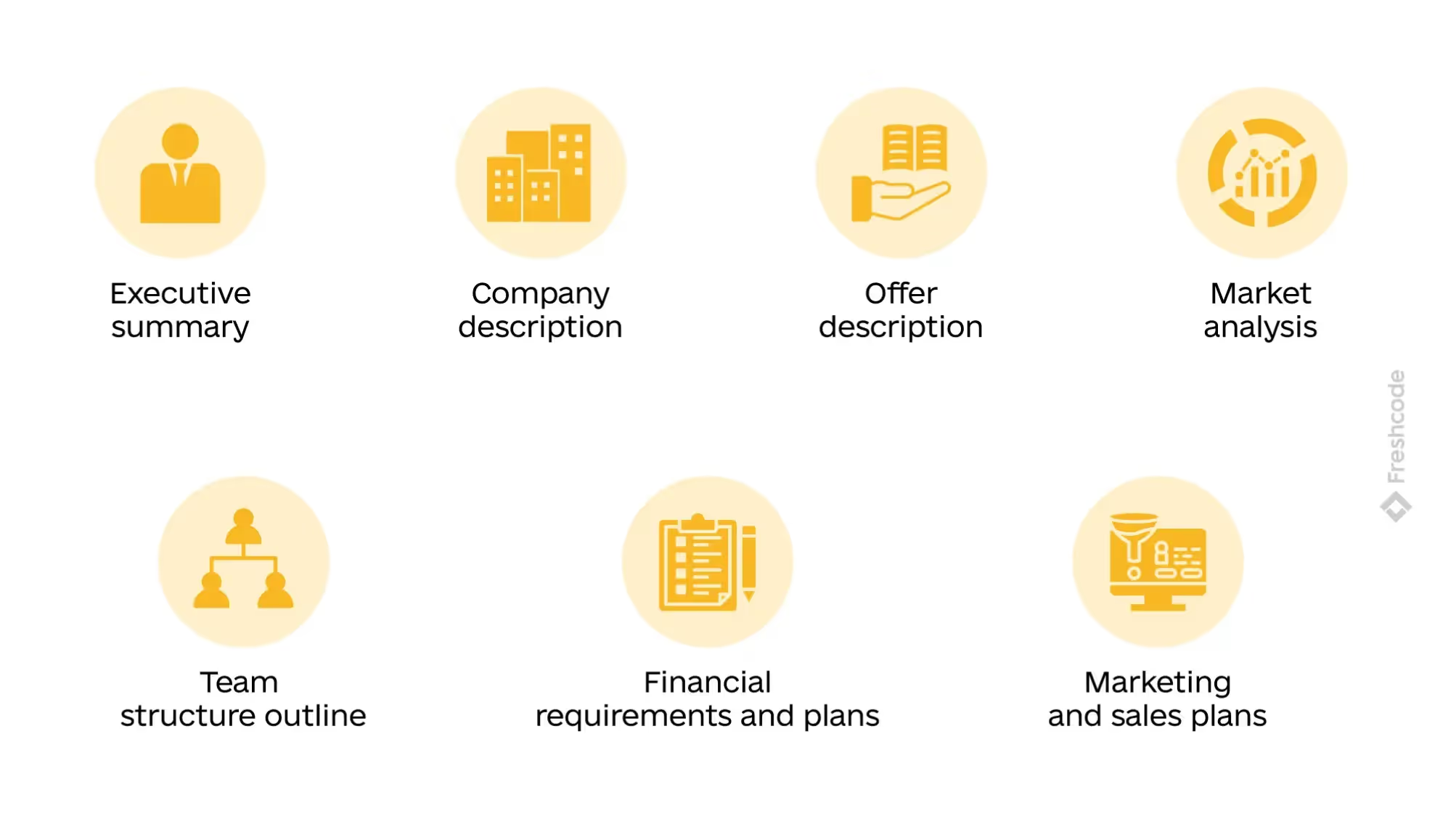
Formalizing your ideas and plans on paper may seem like a waste of time, but according to HBR, writing a business plan makes you <medium>16% more likely to succeed<medium>. Besides, planning helps founders clean up their ideas, achieve their full potential, find the right people for the team, secure funding, and sell their businesses. While plenty of business plan templates exist, there's no one correct way to create yours. However, there are crucial sections you must always include, such as:
1
Executive summary
The first section should be the last one you write, as it's a condensed version of your business plan that explains your business and product in a handful of paragraphs.
2
Company description
Explain your business model and growth strategies, values, mission, and structure.
3
Offer description
Go into detail about what you're going to offer to the customers, including the unique value proposition you've determined when you found the product/ market fit. A pricing model should also make an appearance.
4
Market analysis
Go into detail about what you're going to offer to the customers, including the unique value proposition you've determined when you found the producThat's where you can formalize all the research you've done into your target audience, competition, and niche as a whole. You may include user personas and segments.t/ market fit. A pricing model should also make an appearance.
5
Marketing and sales plans
Think of the most impactful way to launch the project, attract leads, and convert them into paying customers. This section should include your primary marketing channels and platforms, as well as customer relationship management (CRM) tools.
6
Team structure outline
With all your plans laid out, think about how many people you need and which roles they should take. You should also consider future scaling possibilities and how much more talent you might need to hire to accommodate explosive growth.
7
Team structure outline
With all your plans laid out, think about how many people you need and which roles they should take. You should also consider future scaling possibilities and how much more talent you might need to hire to accommodate explosive growth.
8
Offer description
Go into detail about what you're going to offer to the customers, including the unique value proposition you've determined when you found the product/ market fit. A pricing model should also make an appearance.
With your business plan ready, you should have a clear picture of the next steps of the new business startup checklist, and your idea is much more likely to attract investors. Next comesthe time to enact the plans you've made.
4. Line up the team
Whether you start an offline or an online business, you will need a team to work on it. Even if you feel you can do everything on your own and have no money to hire anyone, you need atleast a second pair of eyes on all decisions.
Think about Internet giants, such as Google, Apple, or Microsoft, that all started with a two-person team. Buzzy Clubhouse social app was launched by two Silicon Valley entrepreneurs.
Moreover, investors are 30% more likely to fund your venture if you have a cofounder. So before you move any further with your business idea:
1
Establish a founding team
Get one or more people to help you manage responsibilities and balance business decisions.
2
Nurture a business culture
Identify startup mission and values, keep them in mind during development, and use them in marketing.
3
Set up a communication framework
Decide on the preferred modes of communication, create meeting templates, start a wiki.
4
Select project management and issue tracking tools
Keep track of the development progress and identify bottlenecks.
It's never too early to think about marketing and sales, even if your company doesn't have a name yet. After all, even the best idea will never see the light of day unless you know how to market and sell it. Just look at Thomas Edison and Nicola Tesla. With all the preliminary strategizing work done at previous stages, now you have to start implementing your plans, including:
1
Brand identity development
You need to decide what emotions you want to inspire, what values you want to transmit through the product, and keep the message consistent throughout all communication channels. Setting up your brand identity early on will promote brand recognition and loyalty.
2
Online presence building
With the target audience and brand identity settled, you can establish social media and advertising accounts to attract the first prospects. Email newsletter, blog, and website are equally important for both marketing and sales strategies.
3
Sales funnel set up
Generating traffic won't help you break even, but turning leads into customers will. You need to decide on your conversion strategy and automate it to guarantee the maximum conversion rate 24/7.
4
Sales tools set up
CRM should be at the top of your priorities list, even if you start with a straightforward spreadsheet listing customer info and purchases. Whether you go the DIY, ready-made, or custom CRM route, it will become a crucial part of your sales infrastructure.
5
Sales goals
If you've written the business plan already, you know exactly how many sales you need to make to break even and let your business grow. Prime your team to meet these goals, analyze why they can't be met, and quickly respond to occurring problems.
6. Register your business and the name
Setting up a business takes lots of time and paperwork. However, you need to take your business structure and brand name issues seriously, as they are likely to stay the same for the foreseeable future. Even if you decide to shorten or change the company name later, you will need to go through the same steps:
1
Decide on a business structure
Startups usually start as sole proprietorships, partnerships, or limited liability companies (LLCs), and only the most successful ones grow into corporations. Each of the options comes with pros and cons when it comes to liability, daily operations, and tax reporting. LLCs are the best for getting initial funding and limiting the owners' personal liability, which makes this structure especially popular among new businesses.
2
Choose and register your brand name
Brainstorm, research, and survey potential customers. Once you have a shortlist of names, learn which ones are available in your state or country, and which are trademarked. After registering your business according to the chosen structure, you can file for a trademark to protect your intellectual property.
Depending on the country your business is registered in and your line of work, you might need to acquire a business license, a seller's permit, and other paperwork necessary to make your business legal. Use advice from the following section to stay out of legal trouble.
7. Avoid legal issues
When starting a business in the USA or anywhere else in the world, you will face dozens of legal decisions. Instead of wasting your time translating legalese into English, find a competent attorney, and ask for advice. Better yet, hire a legal advisor to handle delicate legal matters. You can even negotiate a deferred payment or offer stocks for their services if your budget cannot handle attorney's charges. Follow our starting a business checklist to avoid legal and regulatory troubles. While there are many more possible precautions, you should at least:
1
Find a lawyer
Set them to take care of incorporation, licenses, permits, contracts, and intellectual property ownership.
2
Allocate equity
Split equity among the founding team members that are interested in the long-term success to avoid future misunderstandings.
3
Get employer ID numbers
Remember both federal and state requirements.
4
Research and set up business insurance policies
Get property and general liability insurance, as well as a business owner's policy.
8. Take care of finances
Running out of money is among the main reasons small business owners fail. However, starting a business checklist accounts for more than just fundraising. Your financial strategy should include everything from fundraising and accounting to exit options. If you have several backup plans to get you out of financial trouble, your startup will be more likely to succeed.
To avoid money issues as a startup founder, you should:
Choose among bootstrapping, loans, equity financing, crowdfunding, or
their combination.
6
Keep exit options open
Be ready to sell your company, go public, or keep running the business
in perpetuity.
9. Get product and business opportunities
Most tips on starting a business deal only with this category, avoiding the complications of dealing with legal and financial issues, or finding a reliable offshore IT vendor. Our online business startup checklist has already taken you through these hurdles, and now it's time to focus on turning your idea into a marketable and profitable product. This process requires you to:
Work on personas and user stories to make the product intuitive
and user-friendly, go through
usability testing.
4
Choose marketing channels
Consider SEO, SMM, PR, word of mouth, and their combinations for maximum
awareness.
5
Develop a business launch strategy
Harness this opportunity to carve out a market share and gain the target
audience's attention.
6
Set up distribution channels
Select online and offline sales platforms or establish an automated
sales system.
7
Harness the data
Collect and analyze product performance data, including acquisition,
activation, retention, referral, and revenue.
8
Scale up your offer
Consider adding new features or expanding to new markets once MVP
development pays for itself and starts generating profit.
In this business startup checklist template, we have tried to answer the WHAT of setting up a business in the USA or elsewhere. We'll explain the HOW in future posts, one point at a time, so stay tuned and sign up for updates. If you are already halfway through this checklist and are now looking for an IT vendor to help with MVP development, Freshcode is a reliable choice, trusted by startups across the globe.
Subscribe to our weekly newsletter
Thank you for subscribing to our newsletter
Oops! Something went wrong while submitting the form.
With a keen understanding of the software development landscape, Alex implements best practices to deliver exceptional experiences for Freshcode clients.