Fintech Software Development Company

Freshcode fintech development services help to create secure and reliable applications to revolutionize the financial industry.

We're a fintech software development company trusted by startups and established businesses across the financial sector in North America and Europe. From the first architecture decision to post-launch support, we bring the technical precision and fintech expertise to make it work.

What Is Fintech
Software Development?

Financial software development covers the design and engineering of digital financial products like payment systems, banking platforms, lending infrastructure, compliance tooling, investment platforms, and the data pipelines that run underneath all of them. It sits at the intersection of financial technology and software engineering, serving fintech companies, banks, and financial service providers of all sizes.

Financial software development covers the design and engineering of digital financial products like payment systems, banking platforms, lending infrastructure, compliance tooling, investment platforms, and the data pipelines that run underneath all of them. It sits at the intersection of financial technology and software engineering, serving fintech companies, banks, and financial service providers of all sizes.

Fintech Software Development Services We Provide

Section title icon

We offer end-to-end fintech software development services across the full product lifecycle from early architecture decisions through to deployment and post-launch support. Our work spans web and mobile, covering everything from customer-facing fintech app development and fintech mobile apps to the backend infrastructure that runs it. As a fintech solutions software development company, we handle financial services products of all sizes and complexity.

Section title icon

Custom Fintech Development

Custom fintech software development starts with your business model. Whether you're building a trading interface, a digital wallet, or a core banking layer, the architecture decisions are made for your specific scale and compliance context.

Payment Software

Secure, fast payment processing integrations and standalone payment custom fintech solutions. We work with card networks, ACH, SEPA, real-time payment rails, and payment gateways, handling the PCI DSS compliance requirements that come with them.

Banking Platforms

Digital banking infrastructure for neobanks, challenger banks, and financial organizations looking to modernize. This includes account management, transaction processing, integration with core banking systems, and mobile banking apps for customers who expect a seamless experience on any device.

Table row icon

Lending Solutions

Loan origination systems, credit scoring engines, automated underwriting systems, and borrower-facing interfaces that meet regulatory requirements while staying usable. We build for both consumer and SMB lending contexts.

Fintech Modernization

Legacy financial systems that worked in 2010 tend to become liabilities by 2025. We help companies in the financial sector re-architect aging fintech platforms to modern, maintainable standards without taking down production.

Ready to build your team? Tell us about your project and we'll match you with the right engineers.

Core Features of Modern Fintech Software

Not every feature matters equally. In financial software, these four tend to determine whether a product is production-grade or not:

Security

Encryption at rest and in transit, fine-grained access controls, audit trails, and secure key management built in from the start, protecting sensitive data before a pen test finds a gap.

Cube icon

Compliance readiness

PCI DSS, GDPR, PSD2, AML/KYC requirements shape data models, retention policies, and API design. We account for them before the first line of code, not during the compliance revi

Reliability

Financial systems need uptime. We design our fintech software development solutions for fault tolerance, graceful degradation, and

Auditability

Regulators and internal risk teams need to trace what happened and when. Immutable transaction logs, structured event records, and clear data lineage are part of the product

Business Benefits of Fintech Software Development

Section title icon

Your team stops doing work that software should handle

Manual reconciliation, paper-based regulatory compliance checks, and fragmented data systems slow down financial management and create risk. Custom fintech software development automates those workflows and consolidates data where it needs to be.

Your team stops doing work that software should handle

Manual reconciliation, paper-based regulatory compliance checks, and fragmented data systems slow down financial management and create risk. Custom fintech software development automates those workflows and consolidates data where it needs to be.

Your team stops doing work that software should handle

Manual reconciliation, paper-based regulatory compliance checks, and fragmented data systems slow down financial management and create risk. Custom fintech software development automates those workflows and consolidates data where it needs to be.

Your team stops doing work that software should handle

Manual reconciliation, paper-based regulatory compliance checks, and fragmented data systems slow down financial management and create risk. Custom fintech software development automates those workflows and consolidates data where it needs to be.

Ready to build your team? Tell us about your project and we'll match you with the right engineers.

Who We Build Fintech Solutions For

Fintech Startups

Early-stage fintech companies building their first financial product. We help you make architecture decisions that don't become blockers at Series B and move fast enough that you actually get to Series B.

Table row icon

Banks and Financial Institutions

Established financial organizations navigating digital transformation. We work with legacy integration constraints, internal procurement processes, and regulatory oversight while still delivering modern software.

Payment Providers

Companies processing payments at volume, where milliseconds and uptime percentages matter. We build for performance, resilience, and the compliance requirements that come with handling cardholder data.

WealthTech Companies

Investment platforms, robo-advisors, and wealth-management tools with complex data requirements and demanding users who notice when the numbers are slow or wrong.

Cube icon

InsurTech Businesses

Insurance products built on modern software infrastructure — from policy management and claims processing to underwriting automation and customer-facing portals.

Ready to build your team? Tell us about your project and we'll match you with the right engineers.

Compliance and Security in Fintech Software

Regulatory compliance in fintech is an ongoing engineering discipline that touches your data models, your APIs, your infrastructure security, and your vendor choices. The regulatory frameworks that govern financial products are architecture constraints that shape how you store data, how you authenticate users, and how you log activity.

We have experience building to these standards:

Security
Section title icon
arrow

PCI DSS: for any system that handles cardholder data. Scoping, tokenization, and encryption decisions are made early to minimize your compliance footprint.

arrow

AML/KYC: identity verification, transaction monitoring, and suspicious activity reporting built into the product, not bolted on afterward.

arrow

GDPR: data minimization, retention controls, consent management, and the right-to-erasure flows that European regulations require.

arrow

PSD2: open banking APIs, strong customer authentication, and the technical standards that European payment regulation demands.

arrow

SOC 2: security, availability, and confidentiality controls for companies that need to demonstrate their posture to enterprise customers or auditors.

Fintech Solutions We Develop

Payment Platforms

Multi-currency processing, merchant settlement, refund handling, dispute management, payment gateways, real-time rails

Lending Solutions

Origination workflows, automated underwriting systems, repayment processing, borrower portals, compliance layer

InsurTech Software

Consumer and business wallets with personal finance management features, multi-currency, KYC-gated, transaction history, top-up/withdrawal

RegTech Platforms

Order management, market data integration, risk controls, execution infrastructure, audit trail

Trading Platforms

Transaction monitoring, regulatory reporting pipelines, case management, watchlist screening

Digital Wallets

Policy issuance, claims intake and processing, underwriting rule engines, reinsurance data integration

Fintech Technology Trends Shaping the Market

Trends

01

Embedded Finance

plus

If you're building a non-financial product, you now have a realistic path to offering loans, insurance, or accounts inside your platform without becoming a financial institution yourself. That changes your monetisation options and your competitive surface in an increasingly competitive fintech market, but it also means your architecture needs to be ready for it. Products that weren't designed with financial features in mind tend to hit hard walls when they try to add them later: identity infrastructure that can't support KYC, data models that weren't built for transaction integrity, APIs that weren't designed to be composable. If embedded finance is anywhere in your roadmap, the time to account for it is during the initial build.

02

Open Banking

plus

Your users already have financial data sitting with their bank. Think, account history, income patterns, spending behavior, etc. Open Banking gives you a legitimate, consent-based way to access it, which means faster onboarding, better credit decisioning, and personalization that doesn't require users to manually tell you what their bank already knows. The catch here is that the integration work is messier than the documentation suggests. Bank API quality varies significantly, consent flows need careful UX design to convert, and the compliance obligations for accessing that data are real. However, getting it right is definitely worth it.

03

AI-Driven Fraud Detection

plus

If your product involves money, fraud is going to be a cost of doing business. The question is how much. Rule-based detection gives you a baseline, but it degrades over time as patterns shift and scammers adapt. The products that keep fraud losses manageable long-term are the ones with models that learn from their own transaction data and adjust. The earlier you instrument your data pipeline to capture the signals those models need, the less painful it is to train them. Bolting on ML-based fraud detection after launch is possible, but building for it from the start is considerably cheaper.

04

Banking-as-a-Service

plus

BaaS means you can launch a financial product, like a wallet, a card, a lending flow, without a banking licence and in a fraction of the time it would have taken five years ago. But it doesn't remove the compliance responsibility. You're still accountable for KYC, for AML monitoring, for how your users' money is handled. The design question is how much of that compliance layer you're building yourself versus relying on your BaaS partner for, and what your contingency looks like if that partner changes terms, raises prices, or has an outage. Those are architecture decisions as much as commercial ones.

Why Choose Freshcode
for Fintech Software Development

10
+

years
120
+

engineers
Multiple fintech products shipped

We've built across the full fintech stack

Our financial software developers have worked across payment infrastructure, lending platforms, digital banking, and compliance tooling long enough to recognise the integration that's going to be messier than the docs suggest, the compliance obligation that wasn't in the original scope, or the data model decision that will constrain you in six months. As a fintech software development company, the expertise we bring to each engagement is pattern recognition built from real fintech projects.

Table row icon

We scope compliance before we write the first line

Regulatory frameworks shape your data model, your access control design, your audit logging, your API contracts. Development teams that treat compliance as a separate workstream end up retrofitting it under pressure, which is slower, more expensive, and leaves gaps. We build to the relevant standards from the start, selecting the optimal technology stack for your compliance context from day one.

We make decisions with your next stage in mind

Scalable architecture decisions made at the beginning of a project either support your growth or constrain it. Our fintech software development services are structured around making those decisions with your next stage in mind, so that scaling doesn't mean starting over. Quality assurance is built into every stage of the process.

Cube icon

We work as part of your team

You work with a consistent, senior-weighted team that stays on the project long enough to properly understand your codebase and your product context. In a domain where context is expensive to rebuild, that continuity is one of the main reasons custom fintech software development with Freshcode doesn't stall mid-project.

We flag problems before they become change orders

Technical constraints surface mid-project. And as scope assumptions turn out to be wrong, the estimates need revisiting. We flag these things early and directly, with enough context for you to make a decision.

Section title icon

Fintech Software Development

Case Studies
Slider card image

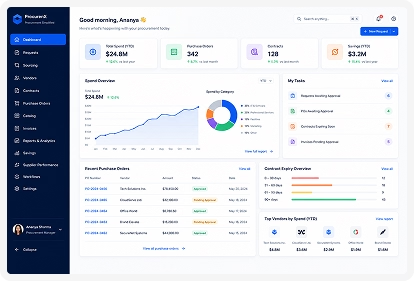
Procurement & Contract Management Platform

A large European bank needed a web platform for energy resource procurement to monitor gas and electricity purchase contracts, track market indicators, forecast prices, and manage payments and deliveries across multiple trading platforms.

01

Solution:

Rebuilt the architecture from scratch, migrated business logic to the backend, introduced a fact-table approach for fast queries, and developed an ETL parser on AWS Lambda.

arrow

Impact:

Application load time dropped to under 2 seconds, new developer onboarding reduced from 3–4 days to 2–3 hours, and the platform now supports real-time energy resource purchases with 5-minute market data refresh.

Slider card image

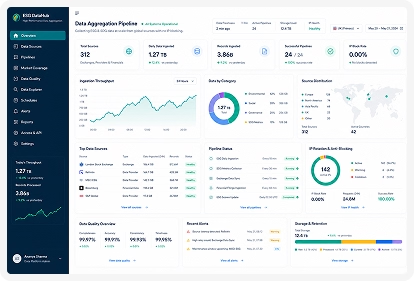
SDG & ESG Analytics and Real-Time Ratings Platform

A UK-based investment research firm needed a high-performance data aggregator to pull ESG and SDG metrics from stock exchanges, funding providers, and financial companies at terabyte-scale daily throughput without being IP-blocked.

02

Solution:

Built with Clojure/ClojureScript, the platform features a custom web-crawling architecture, OCR, data parameterization, and a multi-server monitoring dashboard that tracks 20+ servers in real time.

arrow

Impact:

Achieved terabyte-per-day data extraction, eliminated hard-coded crawler logic for easy scaling, and significantly accelerated the client's development velocity.

FAQ

Q&A

Why hire a fintech software development company instead of building in-house?

plus

Building in-house works well when financial software development is your core business and you're ready to hire and retain what that requires: senior fintech developers, compliance engineers, security specialists. For most companies, that's significant overhead before the product is validated.

Fintech software outsourcing to a specialist dedicated development team like a fintech software development agency gives you that depth without the recruiting timeline or fixed cost. You can scale the team up or down as fintech projects demand, which in-house headcount rarely allows. Staff augmentation is worth considering if you already have a team but need to fill specific capability gaps around security, compliance, or a particular stack.

How much does fintech software development cost?

plus

It depends heavily on scope, compliance requirements, and integration complexity. A focused fintech MVP is a different budget conversation from a full banking platform with multi-currency support and regulatory reporting.

For context on the market you're building in: the global fintech market is projected to reach $851 billion by 2030, growing at a CAGR of 18.5%, driven by increasing digital adoption and innovations in payment systems. The demand for well-built financial software isn't slowing down, and the cost of building it badly tends to exceed the cost of building it right the first time. The most useful starting point is a scoped discovery phase where we define the architecture, identify compliance obligations, and produce a realistic estimate.

How long does it take to develop fintech software?

plus

A well-scoped fintech MVP can reach production in three to five months. More complex fintech platforms typically run six to eighteen months, with meaningful milestones along the way.

The fintech software development process typically follows a structured six-phase approach that includes Discovery and Strategy, Design and Prototyping, Agile Development, Testing and Quality Assurance, Deployment and Launch, and Support and Optimization. The Agile Development phase involves two-week sprint cycles with continuous integration and deployment, ensuring alignment through daily standups, sprint planning, and retrospectives. Timeline is mostly a function of compliance scope and third-party integration complexity, and we establish this clearly during discovery.

How do you ensure security and compliance in fintech software?

plus

Fintech software collects and processes sensitive data, making it a lucrative target for cyberattackers. That reality shapes how we approach every engagement. An integral part of financial software development projects is an elaborate cybersecurity strategy designed to tackle all potential data protection risks, which includes secure development practices, regular security testing, and robust security measures such as end-to-end encryption and multi-factor authentication.

Modern security best practices in fintech include field-level encryption, tokenization of sensitive data, and off-platform vaulting, with Hardware Security Modules (HSMs) enhancing protection by securely managing encryption keys. Regulatory compliance requirements shape the data model, the access control design, and the audit logging approach before the first line of code is written.

Comprehensive testing in the fintech software development services includes functional testing, load and performance testing, security testing, and user acceptance testing to ensure compliance and quality before deployment. Post-launch support and optimization are crucial for maintaining performance, implementing security updates, and enhancing features based on user feedback and analytics.

Share your idea

Uploading...
fileuploaded.jpg
Upload failed. Max size for files is 10 MB.
Thank you! Your submission has been received!
Oops! Something went wrong while submitting the form.
What happens after
you fill this form?
We review your inquiry and respond within 24 hours
A 30-minute discovery call is scheduled with you
We address your requirements and manage the paperwork
You receive a tailored budget and timeline estimation

Talk to our expert

Nick Fursenko

Nick Fursenko

Account Executive

With our proven expertise in web technology and project management, we deliver the solution you need.

  • We review your inquiry and respond within 24 hours

  • A 30-minute discovery call is scheduled with you

  • We address your requirements and manage the paperwork

  • You receive a tailored budget and timeline estimation

anchor